De-icing techniques that will amaze you
and this one here, not sure where this video was shot
Thursday, 10 January 2019
Thursday, 20 September 2018
Adverse Weather and its Effects on Air Safety - A Presentation Made at Portcullis House London - Weather is becoming more extreme, detection of it poorer and operational control and supervision in Europe should be improved to help pilots avoid the worst of the weather
Adverse WX&AV Safety Final by on Scribd

Monday, 21 November 2016


Monday, 14 November 2016

Sunday, 31 July 2016
Saturday, 7 May 2016


Saturday, 23 April 2016
Flydubai B737-900 A6-FDM Accident Rostov on Don URRR
Source of this report is unknown
Flydubai crash investigators suggest Pilot Go-Around Errors:

Russian's Interstate Aviation Committee (IAC) has issued five "prompt"
safety recommendations in its interim report on the crash of Flydubai flight 981, a Boeing 737-800 that plunged into the ground after a second missed approach at the Rostov-on-Don airport early on the morning of March 19, killing all 62 aboard.
Potential disorientation
Four of the recommendations address pilot actions and potential disorientation during go-arounds (or missed approaches) with both engines operating near the end of a flight, when aircraft weight is lower and the engines provide more acceleration. A fifth recommendation calls for Boeing
737-800 operators to take note of the findings.
The early recommendations hint that disorientation as a result of the dynamic maneuver-a full-power go-around with both engines operating and low aircraft weight after six hours of flying-could have played a major role in the crash. Fatigue or circadian rhythm issues could also be involved, given the aircraft was attempting the second landing at approximately 3:30 a.m.
local time.
Flight recorders
Based on flight data recorder (FDR) and cockpit voice recorder information, an international team of investigators determined that crew abandoned the second instrument landing system approach to Runway 22 at a height of 722 ft., then climbed to steeply to approximately 3,280 ft. before entering a steep dive and crashing 400 ft. past the threshold of Runway 22.
What happened during that climb will be key to solving the mystery. Data shows pilots may have initiated the second abort due to an abrupt 20 kt.
increase in indicated airspeed, possibly signaling wind shear. The pilots in response set maximum power to the engines, raised the landing gear and began climbing at approximately 4,000 ft./min. Investigators said the final portion of both approaches had been flown with the autopilot and autothrottle systems turned off, but the flight director turned on. The flight director provides a visual indication on the primary flight display of how the pilot should control the aircraft to follow a pre-programmed course.
At a height of 1,900 ft. with a pitch attitude of 18 degrees nose-up, the pilot-flying pushed forward on the control column, causing the flaps, which had been set at 15 degrees, to automatically retract to 10 degrees to prevent over-speed damage. After a reduction in power, the crew then restored full power and the pilot-flying pulled back on the control column resulting in a climb rate of about 3,200 ft./min.
At approximately 3,000 ft. height, investigators said there was a "simultaneous" control column nose-down input and stabilizer nose-down deflection. Pilots use the control column to deflect the elevator while an electrical switch on the control column can be used to move the stabilizer to provide trim control. The FDR showed that the stabilizer nose-down trim control input lasted 12 seconds, and the CVR verified the sound of the trim system in motion. The combination of control inputs resulted in a -1G push-over that resulted in a steep dive from which the crew did not recover.
Additional training on Go-Arounds (GA)
Two recommendations call for airlines to provide "additional training,"
including simulator scenarios, on go-arounds with two engines operating from various heights and lower aircraft weights.
The IAC also wants airlines to study the safety recommendations it issued after the November 2013 crash of a Tatarstan Airlines Boeing 737-500 at Kazan, and the May 2006 crash of an Armavia Airbus A320 near Sochi. Both crashes involved crew mistakes in part caused by higher than normal accelerations caused by two-engine go-arounds. Potential illusions include somatogravic illusions, which can lead a pilot to believe that forward acceleration is causing the aircraft is pitch up steeply.
Another recommendation calls on airlines to analyze recommendations made by the French safety agency BEA in its August 2013 Aeroplane State Awareness during Go-Around (Asaga) study.
BEA concluded that pilots are ill-prepared for go-arounds, relatively rare events where many actions must be completed in a short time, leaving little margin for error in handling automation and control of the aircraft. Failure to handle either can lead to a loss of control.
Along with calling for somatogravic illusions to be incorporated into simulators, the BEA also recommended more training for go-arounds, particularly with both engines operating, and installation of devices to limit thrust during go-around.
Flydubai crash investigators suggest Pilot Go-Around Errors:

Russian's Interstate Aviation Committee (IAC) has issued five "prompt"
safety recommendations in its interim report on the crash of Flydubai flight 981, a Boeing 737-800 that plunged into the ground after a second missed approach at the Rostov-on-Don airport early on the morning of March 19, killing all 62 aboard.
Potential disorientation
Four of the recommendations address pilot actions and potential disorientation during go-arounds (or missed approaches) with both engines operating near the end of a flight, when aircraft weight is lower and the engines provide more acceleration. A fifth recommendation calls for Boeing
737-800 operators to take note of the findings.
The early recommendations hint that disorientation as a result of the dynamic maneuver-a full-power go-around with both engines operating and low aircraft weight after six hours of flying-could have played a major role in the crash. Fatigue or circadian rhythm issues could also be involved, given the aircraft was attempting the second landing at approximately 3:30 a.m.
local time.
Flight recorders
Based on flight data recorder (FDR) and cockpit voice recorder information, an international team of investigators determined that crew abandoned the second instrument landing system approach to Runway 22 at a height of 722 ft., then climbed to steeply to approximately 3,280 ft. before entering a steep dive and crashing 400 ft. past the threshold of Runway 22.
What happened during that climb will be key to solving the mystery. Data shows pilots may have initiated the second abort due to an abrupt 20 kt.
increase in indicated airspeed, possibly signaling wind shear. The pilots in response set maximum power to the engines, raised the landing gear and began climbing at approximately 4,000 ft./min. Investigators said the final portion of both approaches had been flown with the autopilot and autothrottle systems turned off, but the flight director turned on. The flight director provides a visual indication on the primary flight display of how the pilot should control the aircraft to follow a pre-programmed course.
At a height of 1,900 ft. with a pitch attitude of 18 degrees nose-up, the pilot-flying pushed forward on the control column, causing the flaps, which had been set at 15 degrees, to automatically retract to 10 degrees to prevent over-speed damage. After a reduction in power, the crew then restored full power and the pilot-flying pulled back on the control column resulting in a climb rate of about 3,200 ft./min.
At approximately 3,000 ft. height, investigators said there was a "simultaneous" control column nose-down input and stabilizer nose-down deflection. Pilots use the control column to deflect the elevator while an electrical switch on the control column can be used to move the stabilizer to provide trim control. The FDR showed that the stabilizer nose-down trim control input lasted 12 seconds, and the CVR verified the sound of the trim system in motion. The combination of control inputs resulted in a -1G push-over that resulted in a steep dive from which the crew did not recover.
Additional training on Go-Arounds (GA)
Two recommendations call for airlines to provide "additional training,"
including simulator scenarios, on go-arounds with two engines operating from various heights and lower aircraft weights.
The IAC also wants airlines to study the safety recommendations it issued after the November 2013 crash of a Tatarstan Airlines Boeing 737-500 at Kazan, and the May 2006 crash of an Armavia Airbus A320 near Sochi. Both crashes involved crew mistakes in part caused by higher than normal accelerations caused by two-engine go-arounds. Potential illusions include somatogravic illusions, which can lead a pilot to believe that forward acceleration is causing the aircraft is pitch up steeply.
Another recommendation calls on airlines to analyze recommendations made by the French safety agency BEA in its August 2013 Aeroplane State Awareness during Go-Around (Asaga) study.
BEA concluded that pilots are ill-prepared for go-arounds, relatively rare events where many actions must be completed in a short time, leaving little margin for error in handling automation and control of the aircraft. Failure to handle either can lead to a loss of control.
Along with calling for somatogravic illusions to be incorporated into simulators, the BEA also recommended more training for go-arounds, particularly with both engines operating, and installation of devices to limit thrust during go-around.
Sunday, 18 October 2015
Adverse Weather and its Effects on Air Safety

 |
| Courtesy of Capt. Michael |
Introduction
Airliners versus adverse weather encounters appear to be increasing,
with resulting damage to airframes and, in the worst cases, loss of the
aeroplane and life. The increased frequency and convective violence associated
with storm clouds, of late, may be associated with climate change and research
on this subject continues.
In recent years there have been two major accidents, both with loss of
life to all on-board, in which adverse weather in the tropics has played a
role. The most recent was a Swiftair MD83 on the 14th July 2014, in Mali and
the other was an Air France A330 on the 1st June 2009 that crashed
into the Atlantic Ocean. Adverse weather was a causal factor in both accidents.
Though the aeroplane types differed, both relied on automatics for managed
flight and the flight crew were experienced (heavy crew, 3 pilots on the A330).
There are similarities with regards to the causal factors in both
accidents:
- Both aeroplanes penetrated mesoscale convective systems (MCS).
- Both accidents were at night.
- Both accidents were caused by the flight crew’s inability to recover from a stall situation induced by adverse weather (Icing - ICI).
- Neither flight was subjected to a regulatory and administered flight watch oversight.
 |
| Recovery of the vertical stabiliser AF447 |
Additionally, on the 28th
December 2014 Air Asia flight QZ8501 was lost in the Karimata Straights and
though a final accident investigation report is yet to be published, adverse
weather may have been a contributory factor
Adverse Weather Forecasting
Detection and Notification
Adverse weather is a catchall for a large variety of atmospheric
phenomenon that can affect the safety of a flight. These range from the
relatively benign, such as fog, to the explosively energetic convective storms
that are commonplace in the tropics. In extreme cases, these storms can produce
up- and down-drafts that far exceed the climb performance of an airliner whilst
their tops sometimes reach 60,000ft. Even smaller storms that do not reach
typical cruise altitudes can produce ill effects through clear air turbulence
and high altitude wind shear. Successfully navigating such weather relies on a concerted
effort from flight planners, Air Traffic Controllers (ATC) and the flight crew
themselves. Each of these groups has access to a distinct set of experience and
data: Planners will be able to access weather forecasts and observations that
can indicate likely conditions along a planned route.
ATC may be able to see weather radar or
satellite images for their sector and they will receive reports from other
aircraft that encounter adverse weather conditions. Flight crews have limited external weather information but can make direct observations of
conditions using the on-board weather radar as well as simple, but often very
effective, visual observations.
In some cases, this safety mechanism can break down, though. Weather
forecasts can be wrong, in some cases the ‘significant weather’ charts miss
regions of bad weather while at other times they may show such large regions of
bad weather as to be too vague to be practicable. Ground and satellite-based
weather data can be out-of-date, particularly in the case of long-haul flights:
The weather information used by the flight planners may be 10 hours old by the
time an aircraft is close to its destination. Lastly, on-board weather radar
does not always detect adverse weather: Its efficacy relies upon the flight
crew correctly manipulating the radar settings to provide an optimum view of
the conditions ahead.
A common occurrence, particularly south of the European Alps, is for
an aircraft to encounter heavy turbulence without any warning. The crew using a
radar tilt setting that is too shallow, meaning that rapidly building
convection is not seen by radar until the aircraft is dangerously close to it,
often causes these surprise encounters. This has, in a number of cases, led to
crew and passenger injuries. For some regions, such as the Alps, the problem is
exacerbated by the congested airspace: Deviating to avoid bad weather may bring
an aircraft too close to other traffic. Managing the dual threat posed by
weather and traffic requires good communication and planning between ATC and
flight crews.
 |
The percentage of all flights (global), subdivided by
aircraft type that passed within 10km of a lightning strike. Measured during
March 2014 – May 2015. Courtesy of Dr Simon Proud, AOPP, University of Oxford.
|
A further problem is that, in some cases, convective storms can
produce broad, dense, clouds composed of very small ice crystals – too small to
be detected by radar. The crystals are, however, still capable of causing
difficulties for the unprepared flight crew. The chain of events that resulted
in the loss of Air France flight 447 began with airspeed sensors obstructed by
ice crystals. Several other flights have also suffered from unreliable airspeed
due to pitot tube obstruction whilst others have experienced engine
difficulties caused by ice crystals building up on internal surfaces. Radar,
therefore, cannot be relied upon to be a foolproof warning system for bad
weather – the skill of the flight crew in manipulating its settings and
interpreting the data it displays is vitally important.
Use of Airborne Radar by Aircrew
In flight, the only equipment pilots have at their disposal for
tactical weather avoidance are the on-board weather radar and the naked eye.
Radar use and interpretation is vital to flight safety. Every pilot studies the
use of weather radar as part of their CPL/MPL/ATPL course. However, as
technologies change, it is difficult for course syllabi to remain current.
Furthermore, flight simulators are often unable to replicate the weather radar
for training purposes. Consequently, pilots can be limited to the information
available in aircraft manuals, instruction during training or learning by
osmosis during line flying. Radars themselves are becoming more automated and
it is all too easy for pilots to simply switch the device on and leave it
alone.
 |
| Storm cell right on the centre line |
For pilots to maximise the information available for decision making
and to enhance their situational awareness, they must manipulate the weather
radar’s controls (tilt, gain, range etc.). The need to scan the most reflective
part of convective activity, to identify where the most intense convection can
be found, cannot always be left to the automatic modes of weather radars.
 |
| Adverse weather detected by airborne radar |
 |
| And this is what was detected |
There are some (unofficial) online resources and videos which can be
used to improve pilots’ knowledge and supplement that found in operators’
literature. Ultimately, responsibility lies with individual pilots to ensure
that they make the most of their on-board radars, know how to use the equipment
installed and understand how to interpret the information presented to them. In
the absence of formal training or recurrent training, this may only be possible
through regular in-flight practice.
Just as important, is understanding the limitations of the fitted
equipment; there are two main issues. Firstly, the low reflectivity of ice
crystals and hail can make weather detection difficult at high altitude. It is
essential to scan the ‘wet’ part of a convective system – which will be found
much lower down – to identify the most active regions. But, it must also be
understood that speckled green returns at high altitude can indicate dangerous
conditions with ice crystals, hail and turbulence. Secondly, appropriate use of
the radar’s range and an appreciation of signal attenuation are vital in
ensuring that pilots do not fly down ‘blind alleys’ or mis-identify ‘hidden’
areas of convection behind other areas of activity. Using this information,
pilots should apply the recommended lateral separation which, depending on
altitude, can be many tens of nautical miles and should, ideally, be upwind.
The future should see enhanced strategic and tactical tools becoming
available to crews via Operational Control and Supervision (OCS) and live
weather data streamed direct to the flight deck.
Finally, if all strategic (flight planning/flight watch) and tactical
(radar/live data/visual) measures fail, pilots may have to resort to mitigating
the effects of adverse weather. We have seen recent incidents of large
transport aircraft suffering Loss of Control In-flight (LOC-I). It is essential
that all pilots are familiar with the required responses. However, as the AF447
accident shows, there is still a place for ‘sitting on our hands’;
notwithstanding the turbulence, when the unreliable airspeed indications first
manifested themselves, simply maintaining the datum pitch attitude and thrust
setting for level flight may have kept the aircraft flying safely until the
checklist allowed the crew to diagnose the problem.
In time, the fidelity of flight simulators will improve and meaningful
upset training should become possible. In the ‘bizjet’ community, some
organisations are already using small, ex-military, swept wing aircraft to train
and refresh upset recoveries. Recently, the FAA mandated recurrent upset
training for commercial pilots and EASA are currently going through a rule
making process to do the same. This will likely require simulator software to
be updated and will take time but, as recent incidents show, the single most
important element in avoiding LOC-I is avoiding or exiting the aerodynamic
stall. In the last few years, the manufacturers of large commercial transport
aircraft have updated their advice and procedures. In terms of the stall, this
is best achieved by prompt, positive action to unload the wing. Furthermore, in
the case of underwing engines, thrust is not used initially due to the pitch
effect and risk of a secondary stall. More generally, current upset recovery
advice should be familiar to all pilots from their basic training. All aircraft
have their own type-specific procedures and characteristics but the essence is
to unload the wings if necessary, roll wings level and recover to level flight;
thrust or power is used as appropriate.
Pilots must have a comprehensive knowledge of radar use, radar
limitations, aircraft performance datums and basic recovery techniques to
ensure safe flight in the dynamic and energetic atmosphere in which we operate.
Operational Control and
Supervision
The accidents involving AF447 and AH5017 flights could have been
averted if European operators were required to comply with vigorous and
vigilant operational control and supervision methodologies.
Other countries and ICAO signatories do have robust systems that are
compliant with national regulations; notable amongst these is the USA with 14 CFR Part 121 and sub-parts E, F, M, N, P, T, U
where the requirements for operational control and supervision is clearly
defined, the high level headings of which are:
- Flight Release (Pre Flight) 121 subpart F
- Flight Following (In-Flight) 121 subpart U
Under these two headings requirements for the safety of a flight are
planned and supervised by qualified people on the ground. This includes, but is
not exhaustive; the assessments of airworthiness, fuel requirements (RCF as
applicable), weather observed and forecast, performance, crew fitness and
avoidance of fatigue, NOTAM and ATM liaison. This oversight augments the safety
of a flight and assists the commander of a flight in his decision making; it
does not override any decision made by the aeroplane commander.
If we look at the case of AF447, active flight watch, of a flight
planned to transit the Inter Tropical Convergence Zone (ITCZ), could have
alerted the crew to an encounter with adverse weather of extreme convectivity
on their planned route, by ground based personnel.
In the case
of AH5017 the departure routing (SID) was changed by the Ouagadougou controller
from the planned Niamey (NY) ROFER, to EPOPO GAO. This routed AH5017 into the
teeth of a mesoscale convective system and though radar was used to guide the
flight around a highly convective storm cell, the proximity of the deviation
was insufficient to avert aerodynamic upset caused by it. Had this flight been
subject to a flight release system the route alteration could not have been
allowed without approval of the operational control centre (Flight Dispatch).
 |
| Courtesy of the BEA AH5017 Interim Report |
GM1 ORO.GEN.110(c) Operator
responsibilities
OPERATIONAL CONTROL
(a) ORO.GEN.110(c) does not
imply a requirement for licensed flight dispatchers or a full flight watch
system.
It is an irony that EASA opinion 01/2014 “Amendment of requirements for flight recorders and underwater locating
devices” concerns the detection of the CVFDR post-crash, yet there is no
concern at the lack of supervision methodologies that could potentially avert
the loss of a flight as well as track the actual position of it, at a minimum
of 15 minute intervals.
AF447 was lost for two years under the South Atlantic Ocean and AH5027
was lost for 23 hours in the Saharan Desert; MH370 is still missing since the 8th
March 2014.
Summary
There have recently been some high profile incidents and accidents in
which adverse weather encounters were or may have been a contributory factor.
For operators and pilots to be able to make sound judgements about the optimum
course of action when faced with severe weather, they need a multi-layered
defence system consisting of strategic (flight planning/flight watch), tactical
(weather radar/live data/ATC) and, as a last resort, physical (visual)
mitigations.
For crews, regular recurrent weather radar training might improve
confidence in using this valuable tool and also situational awareness when
confronted with adverse weather encounters. The radar is far from a ‘turnkey
solution’ and requires an enhanced knowledge about the specific radar and its
use in terms of optimum settings to correctly interrogate and interpret the
weather display. It is also vitally important that the limitations of the radar
are trained and updated as technologies improve. Also placing more emphasis on
traditional pilot handling skills, both in basic training and in recurrent and
initial type conversion, would be of value if a crew were to find themselves
with an in-flight upset following a weather encounter.
Current EU regulations make for lightweight operational control and
supervision. Improved operational oversight, similar to FAR Part 121, is a thorough
means to provide up-to-date weather information, perhaps via the ACARS, which
is of particular relevance for long-haul flights where the weather in-flight
may be significantly different from the planning forecasts. Furthermore, this
method of operational oversight might also be of benefit in the worst-case of a
‘lost’ flight in finding the most likely location to begin a search.
With airspace becoming ever-more-congested it is possible that weather
encounters may increase, in part due to lack of alternative routings. We
consider that greater operational oversight along with enhanced pilot training
may go some way towards mitigating this risk.
Air Safety Group
September 2015


Friday, 17 January 2014
Latest Battery Problems Ground Japan B787s

Click here Battery Problems on JAL B787
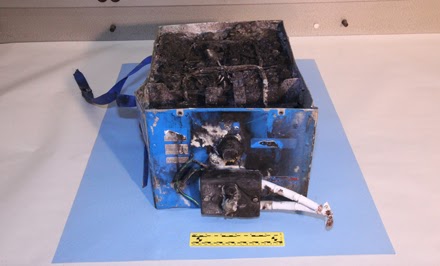
This LIB caught fire in a B787 whilst the aircraft was on the ground in Boston more pictures from the NTSB site click here B787 LIB Fire Boston
Electronic Flight Bags EASA Latest With AMC 20-25
 On behalf of the PACTS (http://www.pacts.org.uk/ ) and the Air Safety Group ( www.airsafetygroup.org)I made a presentation in Westminster Hall to politicians and regulators from the CAA on the dangers to air safety that the use of an EFB on the flight deck can present. There is a CRD (Comment Response Document) to NPA 2012-02 which can be found here on page 6 EASA NPA 2012-02.
 By way of the EASA CRT (Comment Response Tool) I have made comments and suggestions, let's see what happens?
Flight Deck Automation - Augmentation or Replacement of Human Flying Skills?

Automatics fitted by one manufacturer has led to a perceived arrogance by them with regards to risk and training. This translates as an attitude crafted by 'supremacy automatics' for example stall recovery training is not necessary because our aeroplanes cannot stall. When one did the inability of the aircrew to recover this situation proved fatal.
Information systems like the Electronic Flight Bag can also hoodwink its users into believing misinformation, again with fatal consequences. As a member of the Air Safety Group in London I wrote a report on this very subject and then made a presentation to politicians and aviation experts and regulators, copies of which
can be read here: EFB Friend or Foe
and my presentations here: EFB Friend or Foe PACTS Presentation
Recommendations made in the report and at the presentation are now being considered by EASA and the CAA for inclusion in EASA AMC 20-25
Thursday, 15 March 2012
PC Tablets and Aviation
If you are considering using an EFB at some time in the future then this article will interest you. PC Tablets are the future and they will become the favourite personal computer of choice very soon. They are already finding their way onto the flight decks of airliners all over the world. But is the Apple IOS operating system and Apple's stand alone policy i.e having nothing to do with Microsoft suitable for aviation flight operations?
Tablet Ownership Triples Among College Students
March 14, 2012, 3:01 am
By Nick DeSantis
 The number of college students who say they own tablets has more than tripled since a survey taken last year, according to new poll results released today. The Pearson Foundation sponsored the second-annual survey, which asked 1,206 college students and 204 college-bound high-school seniors about their tablet ownership. The results suggest students increasingly prefer to use the devices for reading.
Not in my opinion.
Tablet Ownership Triples Among College Students
March 14, 2012, 3:01 am
By Nick DeSantis
The number of college students who say they own tablets has more than tripled since a survey taken last year, according to new poll results released today. The Pearson Foundation sponsored the second-annual survey, which asked 1,206 college students and 204 college-bound high-school seniors about their tablet ownership. The results suggest students increasingly prefer to use the devices for reading.
One-fourth of the college students surveyed said they owned a tablet, compared with just 7 percent last year. Sixty-three percent of college students believe tablets will replace textbooks in the next five years—a 15 percent increase over last year’s survey. More than a third said they intended to buy a tablet sometime in the next six months.
This year’s poll also found that the respondents preferred digital books over printed ones. It’s a reversal of last year’s results and goes against findings of other recent studies, which concluded that students tend to choose printed textbooks. The new survey found that nearly six in 10 students preferred digital books when reading for class, compared with one-third who said they preferred printed textbooks.
The new survey results arrive as several new tools have emerged this year to simplify digital publishing, including Apple’s self-publishing software and Inkling’s enterprise platform for large companies.
Harris Interactive, the same firm that conducted last year’s survey on behalf of the Pearson Foundation, conducted the poll in January. Figures for age, sex, household income and other factors were weighted to be representative of the U.S. population of college students.
Tuesday, 13 March 2012
EASA CRD Part FTL
The latest regarding the Flight Time Limitation Scheme from EASA OPS can be read here:
CRD to NPA 2010-14 (Part FTL)
CRD to NPA 2010-14 (Part FTL)
Thursday, 1 March 2012
European Emissions Trading Scheme. With So Many Nations Opposed to it It Is time the Scrap this Unwanted TAX
UK hands out first free aviation emission permits
Airlines with a registry account receive permits to help them comply with EU emissions trading rules
The UK has today begun issuing free carbon permits to airlines participating in the EU's Emissions Trading Scheme (ETS). The first EU Aviation Allowances (EUAAs) have been handed out to a number airlines who have fully completed the process for opening registry accounts, a statement issued by the Department of Energy and Climate Change (DECC) said.The department was unable to immediately confirm how many permits had been issued or to which operators. Airlines joined the EU ETS at the beginning of this year after Brussels saw off a legal challenge from US carriers. However, the threat remains that some non-EU airlines will not take part after the US Congress declared its opposition to the scheme, China reportedly banned its carriers from taking part, and Russian officials signalled they could do likewise.
A meeting in Moscow last month saw 26 countries, including the US, China, Russia and India, agree to a basket of countermeasures designed to challenge the EU's inclusion of airlines in the ETS. These countries contend the scheme contravenes international aviation treaties and will increase the cost burden on an industry already struggling with rising oil prices and falling passenger numbers. Analysts Thomson Reuters Point Carbon estimate compliance will cost airlines €505m in the first year, although this falls to €360m if the sector uses its full offset quota. Separate EU estimates have suggested the scheme will add no more than around €3 a ticket for long haul flights in and out of the bloc. Around 85 per cent of the permits airlines need in 2012, roughly 183 million EUAAs, will be issued for free, with the remainder being auctioned. DECC has said it expects to auction about seven million EUAAs each year, but will hand out around 18 per cent of the UK's total 57 million allocation to BA, while Virgin and easyJet are expected to receive more than three million EUAAs in 2012.
Russians fires first shot in EU aviation emissions trade war
From Airbus flagship to Chinese pawn
The warning that Hong Kong Airlines (HKA) could scrap its 10 A380 orders in retaliation for European carbon tariffs opens an intriguing new front in the war being waged against the EU emissions trading scheme (ETS).
The threat – reported in a Chinese newspaper – might well prove to be bluster, but it does illustrate the wide political arsenal at the Chinese government’s disposal.
"We cannot do something which is against our country's interests," the newspaper quoted HKA president Yang Jianhong as saying.
In the United States, where opposition to ETS is fiercest, no such pressure can be brought to bear, though individual airlines could, of course, seek to indirectly influence the European Union through their Airbus order-books.
It would be surprising if any did so, however, as privately-run airlines operate on a commercial rather than political basis and, make no mistake, the case against the imposition of carbon trading on non-European carriers is a political rather than financial one.
This column has examined the economics of ETS before and will not repeat the exercise. Suffice to say, in its current guise the scheme will have no significant impact on ticket prices (as well as having scant effect on airline emissions).
The real concern is one of sovereignty and the projection of EU power outside its own borders. The complexity of international law in this area is only heightened by the tangled web of international and bi-lateral aviation treaties signed over the past 70 years or so.
Whatever the legal rights and wrongs of ETS, almost every nation outside Europe feels aggrieved by it, and others may follow the Chinese example, notably Russia.
No Russian carrier has ordered the A380 yet and, if he so desired, Vladimir Putin could easily ensure that situation continued.
Airbus’ superjumbo sits on 253 orders at present, either very close or very far from making a profit, depending on an estimated break-even sales total for the programme that has ranged from 250 to 420 units delivered.
Quite what pressure European politicians feel to see it reach profitability is another question.
The End of Silverjet

Farewell it was fun whilst it lasted.
Tuesday, 28 February 2012
Can Electronic Flight Bags Compromise Air Safety?
Answer: Yes and They Already Have!
Review of Safety Reports Involving Electronic Flight Bags
U.S. Department of Transportation Research and Special Programs Administration John A. Volpe National Transportation Systems Center
From a ground operations perspective support for and operational involvement with EFBs is growing yet the training required of them by European aviation regulators is non existent.
There has already been one incident where the assistance of ground operations staff in the computation of take off performance came close to causing an accident to an airliner. So where are all the checks and whistles as far as a piece of equipment that has air safety critical consequences is concerned? Well EASA AMC 20-25 is one place to start but does this document detail essential training for ground staff that are involved with the operational support of the EFB? No; Paragraph 7.12 details flight crew training but nothing for Ground Operations and yet they are often required to provide operational support the EFB especially out of hours and especially where the failure of the EFB could compromise on time performance.
It must be time whereby EASA rethink their regulatory policy with regards to Ground Operations (starting by changing the title - it is most confusing and most misunderstand it) and formalise the regulation of it on a similar style to that of the FAA.
Review of Safety Reports Involving Electronic Flight Bags
U.S. Department of Transportation Research and Special Programs Administration John A. Volpe National Transportation Systems Center
From a ground operations perspective support for and operational involvement with EFBs is growing yet the training required of them by European aviation regulators is non existent.
There has already been one incident where the assistance of ground operations staff in the computation of take off performance came close to causing an accident to an airliner. So where are all the checks and whistles as far as a piece of equipment that has air safety critical consequences is concerned? Well EASA AMC 20-25 is one place to start but does this document detail essential training for ground staff that are involved with the operational support of the EFB? No; Paragraph 7.12 details flight crew training but nothing for Ground Operations and yet they are often required to provide operational support the EFB especially out of hours and especially where the failure of the EFB could compromise on time performance.
It must be time whereby EASA rethink their regulatory policy with regards to Ground Operations (starting by changing the title - it is most confusing and most misunderstand it) and formalise the regulation of it on a similar style to that of the FAA.
Modern Cockpits Diminish Pilot Skill Levels
Could Civil Aviation Learn From Military Fly-by-Wire Pilot Training?
WASHINGTON (AP) — Pilots' "automation addiction" has eroded their flying skills to the point that they sometimes don't know how to recover from stalls and other mid-flight problems, say pilots and safety officials. The weakened skills have contributed to hundreds of deaths in airline crashes in the last five years.
Some 51 "loss of control" accidents occurred in which planes stalled in flight or got into unusual positions from which pilots were unable to recover, making it the most common type of airline accident, according to the International Air Transport Association.
"We're seeing a new breed of accident with these state-of-the art planes," said Rory Kay, an airline captain and co-chair of a Federal Aviation Administration advisory committee on pilot training. "We're forgetting how to fly."
Opportunities for airline pilots to maintain their flying proficiency by manually flying planes are increasingly limited, the FAA committee recently warned. Airlines and regulators discourage or even prohibit pilots from turning off the autopilot and flying planes themselves, the committee said.
Fatal airline accidents have decreased dramatically in the U.S. over the past decade. However, The Associated Press interviewed pilots, industry officials and aviation safety experts who expressed concern about the implications of decreased opportunities for manual flight, and reviewed more than a dozen loss-of-control accidents around the world.
Safety experts say they're seeing cases in which pilots who are suddenly confronted with a loss of computerized flight controls don't appear to know how to respond immediately, or they make errors — sometimes fatally so.
A draft FAA study found pilots sometimes "abdicate too much responsibility to automated systems." Because these systems are so integrated in today's planes, one malfunctioning piece of equipment or a single bad computer instruction can suddenly cascade into a series of other failures, unnerving pilots who have been trained to rely on the equipment.
The study examined 46 accidents and major incidents, 734 voluntary reports by pilots and others as well as data from more than 9,000 flights in which a safety official rides in the cockpit to observe pilots in action. It found that in more than 60 percent of accidents, and 30 percent of major incidents, pilots had trouble manually flying the plane or made mistakes with automated flight controls.
A typical mistake was not recognizing that either the autopilot or the auto-throttle — which controls power to the engines — had disconnected. Others failed to take the proper steps to recover from a stall in flight or to monitor and maintain airspeed.
The airline industry is suffering from "automation addiction," Kay said.
In the most recent fatal airline crash in the U.S., in 2009 near Buffalo, N.Y., the co-pilot of a regional airliner programmed incorrect information into the plane's computers, causing it to slow to an unsafe speed. That triggered a stall warning. The startled captain, who hadn't noticed the plane had slowed too much, responded by repeatedly pulling back on the control yoke, overriding two safety systems, when the correct procedure was to push forward.
An investigation later found there were no mechanical or structural problems that would have prevented the plane from flying if the captain had responded correctly. Instead, his actions caused an aerodynamic stall. The plane plummeted to earth, killing all 49 people aboard and one on the ground.
Two weeks after the New York accident, a Turkish Airlines Boeing 737 crashed into a field while trying to land in Amsterdam. Nine people were killed and 120 injured. An investigation found that one of the plane's altimeters, which measures altitude, had fed incorrect information to the plane's computers.
That, in turn, caused the auto-throttle to reduce speed to a dangerously slow level so that the plane lost lift and stalled. Dutch investigators described the flight's three pilots' "automation surprise" when they discovered the plane was about to stall. They hadn't been closely monitoring the airspeed.
Last month, French investigators recommended that all pilots get mandatory training in manual flying and handling a high-altitude stall. The recommendations were in response to the 2009 crash of an Air France jet flying from Brazil to Paris. All 228 people aboard were killed.
An investigation found that airspeed sensors fed bad information to the Airbus A330's computers. That caused the autopilot to disengage suddenly and a stall warning to activate.
The co-pilot at the controls struggled to save the plane, but because he kept pointing the plane's nose up, he actually caused the stall instead of preventing it, experts said. Despite the bad airspeed information, which lasted for less than a minute, there was nothing to prevent the plane from continuing to fly if the pilot had followed the correct procedure for such circumstances, which is to continue to fly levelly in the same direction at the same speed while trying to determine the nature of the problem, they said.
In such cases, the pilots and the technology are failing together, said former US Airways Capt. Chesley "Sully" Sullenberger, whose precision flying is credited with saving all 155 people aboard an Airbus A320 after it lost power in a collision with Canada geese shortly after takeoff from New York's LaGuardia Airport two years ago.
"If we only look at the pilots — the human factor — then we are ignoring other important factors," he said. "We have to look at how they work together."
The ability of pilots to respond to the unexpected loss or malfunction of automated aircraft systems "is the big issue that we can no longer hide from in aviation," said Bill Voss, president of the Flight Safety Foundation in Alexandria, Va. "We've been very slow to recognize the consequence of it and deal with it."
The foundation, which is industry supported, promotes aviation safety around the world.
Airlines are also seeing smaller incidents in which pilots waste precious time repeatedly trying to restart the autopilot or fix other automated systems when what they should be doing is "grasping the controls and flying the airplane," said Bob Coffman, another member of the FAA pilot training committee and an airline captain.
Paul Railsback, operations director at the Air Transport Association, which represents airlines, said, "We think the best way to handle this is through the policies and training of the airlines to ensure they stipulate that the pilots devote a fair amount of time to manually flying. We want to encourage pilots to do that and not rely 100 percent on the automation. I think many airlines are moving in that direction."
In May, the FAA proposed requiring airlines to train pilots on how to recover from a stall, as well as expose them to more realistic problem scenarios.
But other new regulations are going in the opposite direction. Today, pilots are required to use their autopilot when flying at altitudes above 24,000 feet, which is where airliners spend much of their time cruising. The required minimum vertical safety buffer between planes has been reduced from 2,000 feet to 1,000 feet. That means more planes flying closer together, necessitating the kind of precision flying more reliably produced by automation than human beings.
The same situation is increasingly common closer to the ground.
The FAA is moving from an air traffic control system based on radar technology to more precise GPS navigation. Instead of time-consuming, fuel-burning stair-step descents, planes will be able to glide in more steeply for landings with their engines idling. Aircraft will be able to land and take off closer together and more frequently, even in poor weather, because pilots will know the precise location of other aircraft and obstacles on the ground. Fewer planes will be diverted.
But the new landing procedures require pilots to cede even more control to automation.
"Those procedures have to be flown with the autopilot on," Voss said. "You can't afford a sneeze on those procedures."
Even when not using the new procedures, airlines direct their pilots to switch on the autopilot about a minute and a half after takeoff when the plane reaches about 1,000 feet, Coffman said. The autopilot generally doesn't come off until about a minute and a half before landing, he said.
Pilots still control the plane's flight path. But they are programming computers rather than flying with their hands.
Opportunities to fly manually are especially limited at commuter airlines, where pilots may fly with the autopilot off for about 80 seconds out of a typical two-hour flight, Coffman said.
But it is the less experienced first officers starting out at smaller carriers who most need manual flying experience. And, airline training programs are focused on training pilots to fly with the automation, rather than without it. Senior pilots, even if their manual flying skills are rusty, can at least draw on experience flying older generations of less automated planes.
Adding to concerns about an overreliance on automation is an expected pilot shortage in the U.S. and many other countries. U.S. airlines used to be able to draw on a pool of former military pilots with extensive manual flying experience. But more pilots now choose to stay in the armed forces, and corporate aviation competes for pilots with airlines, where salaries have dropped.
Changing training programs to include more manual flying won't be enough because pilots spend only a few days a year in training, Voss said. Airlines will have to rethink their operations fundamentally if they're going to give pilots realistic opportunities to keep their flying skills honed, he said.
Subscribe to:
Posts (Atom)